


What is the project about?
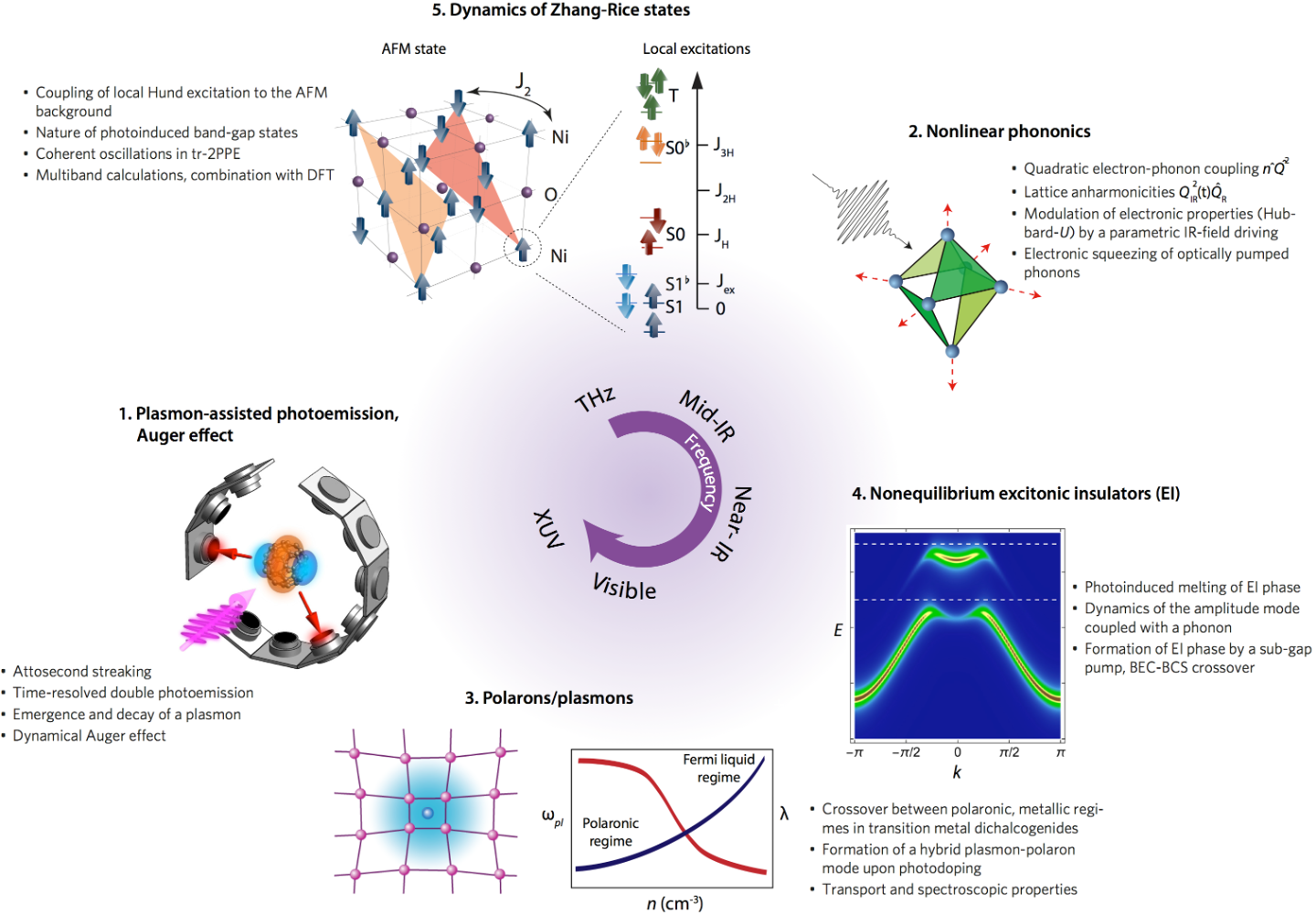
The study of nonequilibrium phenomena in correlated materials has recently become one of the most active and exciting branches of condensed matter physics. This is largely due to advances in light sources and time-resolved spectroscopies on the ultra-short time scales, which made it possible not only to observe and describe but also to design systems with new remarkable properties by coupling them to external electro- magnetic fields. The goal of this project is to study correlation between electrons, phonons, excitons and other quasiparticles in excited quantum states of matter. The behavior of atomic, molecular and solid state systems interacting with laser fields on the femtosecond time-scale will be investigated with the help of nonequilibrium Green’s function approach also known as quantum kinetics. In novel quantum materials, the vastly different energy and time scales and the quantum nature of the involved bosonic particles pose considerable challenges for theory.
Therefore, we will exploit our recently developed (2021) time-linear formalism for solving quantum kinetics equations using the so-called generalized Kadanoff-Baym ansatz. Some striking applications to photoinduced dynamics of organic molecules, carrier and exciton dynamics in 2D materials and electron-phonon thermalization have already been demonstrated. However, we are just at the beginning of these exciting developments of making the method a practical and versatile tool for multiscale real-world applications. My objective is to extend the method towards new materials such as excitonic insulators, strongly-correlated and magnetically-ordered systems and to expand the spatial and time ranges of time-resolved first principles simulations. This will improve our understanding of excited quantum states of matter. In a long time perspective they may lead to practical applications having a huge societal impact. Numerous applications in photovoltaics, superconductivity, and molecular electronics are expected.
Project Scope
The study of nonequilibrium phenomena in correlated materials has recently become one of the most active and exciting branches of condensed matter physics. This is largely due to advances in light sources and time-resolved spectroscopies on the ultrashort time scales, which made it possible not only to observe and describe but also to design systems with new remarkable properties by coupling them to external electromagnetic fields. In a long time perspective they may lead to practical applications having a huge societal impact.
There are already some prominent examples such as the Floquet engineering of topological insulators, the light-induced superconductivity, and insulator-metal and hidden phase transitions. These prospective applications and associated theoretical challenges motivate me to investigate electron dynamics of systems with nonlinear electron-phonon coupling, excitonic insulators, and transition metal dichalcogenides using nonequilibrium Green's function theory. I will rely on our recent progress in solving the Kadanoff-Baym equations using the generalized Kadanoff-Baym ansatz. This will allow me to study the build-up of screening upon the optical perturbation, excitonic insulator instability, and the dynamical modification of Hubbard-U in strongly correlated systems and to include lattice dynamics into the consideration.
Publications
Yaroslav Pavlyukh, Riku Tuovinen, Enrico Perfetto, Gianluca Stefanucci
Physica Status Solidi. B, Basic Solid State Physics, 2024, vol. 261, nr 9, art. 2300504
https://doi.org/10.1002/pssb.202300504
Yaroslav Pavlyukh
Physica Status Solidi. B, Basic Solid State Physics. 2024, vol. 261, nr 9, art. 2300510
https://doi.org/10.1002/pssb.202300510
Megha Gopalakrishna, Yaroslav Pavlyukh, Claudio Verdozzi
Physica Status Solidi. B, Basic Solid State Physics. 2024, vol. 261, nr 9, art. 2300576
https://doi.org/10.1002/pssb.202300576
Riku Tuovinen, Yaroslav Pavlyukh
Nano Letters. 2024, vol. 24, nr 29, s. 9096-9103
https://doi.org/10.1021/acs.nanolett.4c02609
Riku Tuovinen, Yaroslav Pavlyukh, Enrico Perfetto, Gianluca Stefanucci
Physical Review Letters. 2023, vol. 130, nr 24, art. 246301
https://doi.org/10.1103/PhysRevLett.130.246301
Mateusz A. Krawczyk, Jarosław Pawłowski, Maciej Marcin. Maśka, Katarzyna E. Roszak
Physical Review. A. 2024, vol. 109, nr 2, art. 022405
https://doi.org/10.1103/PhysRevA.109.022405
Karol Kawa, Paweł Machnikowski
Physical Review. B. 2024, vol. 109, nr 22, art. 224205
https://doi.org/10.1103/PhysRevB.109.224205
News
Lectures at YAMBO SCHOOL – ROME 2023
Ab initio many-body perturbation theory: from equilibrium to time-resolved spectroscopies and nonlinear optics
May 22-26 2023
Argiletum, Sala Urbano VIII
Via Madonna dei Monti 40
Rome, Italy
Lecture at the Progress in Non-equilibrium Green’s Functions 8 (PNGF8) conference
August 7-11, 2023
Örebro University, Sweden
This research is part of the project No. 2021/43/P/ST3/03293 co-funded by the National Science Centre and the European Union Framework Programme for Research and Innovation Horizon 2020 under the Marie Skłodowska-Curie grant agreement no. 945339.